
Discovery & Sources
Discovery turns your target search into source queries, checks returned jobs against that intent, and prepares admitted leads for scoring and materials. This page owns the target-search controls, source/runtime settings, scheduling, crawl policy, and supervised contact-research boundary. For the end-to-end loop, start with Daily Workflow; for providers and the shared spend ceiling, use Configuration.
Process summary: compile local target intent; query broad boards or enumerate configured ATS and Workday sources; extract and normalize returned postings; accept only postings whose titles and locations match; persist accepted jobs in local SQLite; then score those saved jobs in a later workflow.
- Compile target intentRoles, locations, work models, tracks, and seniority floors define what JobCtrl should look for.Local intent
- Query or enumerate sourcesBroad boards receive compiled queries; configured ATS and Workday sources enumerate their postings.Board searchATSWorkdayNetwork sources
- Extract and normalizeReturned listings are extracted and mapped into one consistent posting shape for the same checks.JobCtrl processing
- Check title and locationEvery returned posting must pass the compiled title rules and accepted-location rules before storage.Title acceptedLocation acceptedAcceptance gate
- Persist accepted jobsAccepted job records are written to the canonical local Discovery store.~/.jobctrl/jobctrl.dbLocal SQLite
- Score the saved jobScoring starts afterward, using the saved posting and the scoring preferences that apply to it.Later workflow
One persistence authority
Every value editable anywhere on /discovery is stored in ~/.jobctrl/jobctrl.db. SQLite is the sole persistence authority for target search, Automation settings, broad-board controls and limits, role-filter execution, source-family parallelism, crawler identity, runtime and schedule, the source registry, locator candidates, quarantine, manual capture, and other Discovery-page state. config.json does not own or provide a fallback for any of these fields.
| Surface | SQLite authority | When a saved change applies |
|---|---|---|
| Target search | Candidate Profile rows | Next Discover run |
| Automation settings | Discovery-owned control rows | Next relevant run or standing-loop poll |
| Runtime and schedule | discovery_settings | Next run or source family; schedule changes require a worker restart |
| Sources, locator candidates, quarantine, and manual capture | Discovery context tables | Immediately for review state; next use for source execution |
Runtime, Sources, And Schedule
Use Discovery → Runtime settings for boards, results per site, posting age, schedule, role-filter mode/model, bounded source-family parallelism, and the outbound user-agent identity. Every saved value goes to SQLite. Schedule changes need a worker restart; boards, limits, and parallelism apply on the next run; role-filter and user-agent changes apply to the next source family.
Parallel families are capped at four and should not exceed the worker's active activity slots. See Concurrency & Fan-out.
Runtime setting reference
The help control beside each Runtime setting opens a short explanation and a deep link to the matching entry below.
Job boards. Choose which broad-board providers run for every generated target query. A Discover execution snapshots the selected boards when the run starts, so a change affects the next run rather than work already in progress.
Results per board. Set the maximum number of results requested from each selected board for one search unit. This is a provider request limit, not a promise that every board will return that many admitted leads; title, location, age, and deduplication checks still apply. The next Discover run snapshots the new value. Admission means a lead is eligible for persistence and enrichment; it is not a relevance score or a judgment that the job is suitable.
LinkedIn search keeps cards listing-only instead of downloading every result's full description. When an admitted sparse card has the same normalized role and genuine employer as another stored job, JobCtrl requests that one posting's detail so content evidence can resolve the possible duplicate before the new-job budget advances. Other admitted cards enter Detail Enrichment for their posting content. If targeted detail is unavailable, JobCtrl preserves the sparse lead and safely keeps it separate rather than dropping it or merging on title and employer alone.
Posting lookback hours. Limit broad-board discovery to postings no older than this many hours when the provider supports age filtering. The next Discover run snapshots the window.
Role title filtering. Choose how returned titles are checked against the target-search plan. Auto uses model-backed matching when a configured model provider is ready and otherwise uses deterministic local title rules. Deterministic always uses local rules. LLM requires model-backed matching. A change applies to the next source family.
Role filter model. Optionally pin the model used by model-backed role-title matching. Leave the value blank to use the configured provider routing. A change applies to the next source family.
Parallel source families. Limit how many source families may crawl at the same time inside a Discover execution. JobCtrl bounds the value to four and to the worker's available activity slots. The next run snapshots the limit; downstream enrichment remains separately bounded.
Crawler product name. Set the product token in JobCtrl's honest outbound user-agent identity. It identifies the crawler without impersonating a browser. A change applies to the next source family.
Crawler contact. Optionally add a URL or contact address to the outbound user-agent identity so site owners can identify the operator. A change applies to the next source family.
Enable scheduled discovery. Control whether worker startup reconciles a recurring Temporal Discover schedule. This is off by default. Restart the worker after changing the setting so it can create or remove the schedule.
Schedule cron. Define the recurring local schedule with a five-field cron expression. JobCtrl uses it only while scheduled discovery is enabled, with SKIP overlap behavior so one scheduled execution does not overlap the next. Restart the worker after changing the expression.
The Discovery page also hosts the Automation settings disclosure. Its minimum-fit, auto-apply, and approval controls affect Apply eligibility and submission, so their behavior is documented in Apply → Approval And Automation Modes.
Canonical identity and repeat applications
Discovery preserves canonical posting identity, source-native identity, source observations, and reviewed duplicate links rather than treating every URL as a different opening. An accepted duplicate link may therefore prove that an alternate URL represents an already-known canonical job. Candidate or rejected duplicate links do not establish that relationship.
Identity evidence alone does not claim that an application happened. Repeat protection combines it only with a confirmed application fact. A conservative same-employer/equivalent-role comparison can require confirmation, but it does not merge the jobs or turn either record into application history. See Apply → Repeat-Application Protection.
Launch And Observe Discovery
Discovery owns the controls that decide what may enter a run; Pipelines owns starting and observing that run. In Pipelines, choose the Discover action, set a bounded result limit, internal source concurrency, optional sources, and dry-run mode, then keep the operations workspace open while work proceeds. The source picker supports up to 50 selections and labels broad-board adapters as JobStreaming; the persisted jobspy: prefix remains only a compatibility ID.
The workspace deliberately keeps different scopes and units separate:
- Current execution is work admitted to the selected Discover execution.
- Execution sweep is eligible pre-existing backlog that execution adopted.
- Global outside execution is unrelated backlog and is not part of the selected execution's completion claim.
- Source-family completion reports source intake as separate running, waiting, and finished family counts; these are source families, not browser processes or Temporal workers. Enrichment and preparation reconciliation report the downstream drain. A finished crawl can therefore coexist with preparation that is still running. Broad-board progress also reports how many interrupted search units resumed. While a board is active, its latest provider traversal facts show completed pages, raw listings, emitted jobs, and whether more pages are known to exist. When the provider does not publish a total page count, JobCtrl says the total is unavailable instead of inventing a percentage or finish time.
- Worker capacity reports Temporal workers and shared activity slots. Source-family internal concurrency is a separate control, and approximate task-queue depth is not a count of domain jobs.
Per-stage rows expose outcomes, existing backlog, capacity, observation time, and ETA. Their completion bar uses an exact N of M finished count rather than the internal term “terminal” or a percentage that can look like active progress. ETA is an observed range with confidence and basis when enough evidence exists; calibrating, paused, stale, unavailable, and no-work states stay explicit instead of becoming a guessed finish time. Freshness and the bounded active-work inventory show whether the operational facts are current.
Exact selected-run stage tracking is durable. New executions record their membership and stage lineage natively. For an execution created by an older JobCtrl version, worker startup and heartbeats rebuild the same lineage from the exact Temporal workflow/run history. During that bounded check, Pipelines shows Checking previous run records, keeps fresh shared-worker and queue facts visible, and hides selected-run counts and ETAs until the recovered key sets have been verified. The check finishes automatically and needs no restart. Partial rows or live-worker telemetry never become a false completion claim.
Stop Or Recover A Discover Run
While the selected Discover workflow is actively discovering or draining, Stop discovery requests Temporal cancellation and refreshes the Pipelines, Runs, and Dashboard read models. A closed workflow that is only draining already-admitted work is not presented as stoppable.
When an execution fails, Pipelines reports whether the runtime inventory shows active work before suggesting another run. A positive total tells you to review that work first; unavailable inventory is reported as unknown, never as idle. If an authoritative history read is temporarily unavailable or cannot yet be mapped unambiguously, JobCtrl says that the previous-run check will retry automatically. It does not present permanent missing tracking, infer completion from partial rows, or require a manual retry. Reconnecting to the exact history restores that run or records its actual closed outcome. If an older run ended before its history recorded every target, JobCtrl marks that run Previous run incomplete, preserves all exact recovered evidence, and does not invent or repeatedly retry the missing remainder. Set up a new Discover run is appropriate only when the prior execution is closed or genuinely absent and fresh runtime capacity confirms zero active slots. It selects the Discover launch controls but does not dispatch anything until you submit them. Raw workflow identifiers, the exact Temporal run ID, and the bounded repair reason code remain available under Technical details.
Resumable Broad-Board Searches
Broad-board discovery uses JobStreaming 0.0.5. At the beginning of the source activity, JobCtrl compiles an immutable unit for every query, target/provider location, and board under the exact Discover workflow/run identity. JobCtrl, not the provider, owns whether that unit is pending, running, completed, failed, skipped, or canceled.
For each posting event, JobCtrl applies the title/location admission policy and commits the admitted lead, source observation, event records, and an idempotent unit receipt before acknowledging the JobStreaming event. The acknowledgement then advances the provider checkpoint. If the process stops in that gap, the event is delivered again and the durable receipt makes the replay harmless. Results rejected by the caller's title/location policy get a separate hashed receipt before acknowledgement. Accepted new/existing counts, filtered counts, and the run-wide new-job limit are therefore read from durable receipts, so a retry cannot lose progress or start the limit over. This intake admission remains separate from the later score and relevance decision.
Temporal retries reclaim only unfinished units with a newer activity-attempt fence. Retryable board errors resume from their checkpoint; an expired board cursor is reset only after its error event has been acknowledged. Request or cursor-schema incompatibility fails explicitly instead of silently starting a different search. Healthy boards and already accepted postings remain useful when another board fails. Pipelines shows N resumed when recovery happened.
JobStreaming page progress is projected separately from JobCtrl acceptance counts. The provider payload contains no cursor or resume dictionary, and the Pipelines operations view binds it to the exact Discover workflow/run before displaying it. These traversal facts explain current crawl activity and never become a synthetic provider percentage when the total is unknown. Pipelines may still estimate the bounded source-family backlog from recent completed-family durations when worker inventory and the Temporal queue are fresh and complete. Dormant global job rows do not block that source-only estimate until they are actually queued or observed as active work. Selected-run sweep demand withholds it only when the unique remaining preparation workflows exceed spare runtime capacity; unbounded retry demand or queue contention always withholds it.
Stop discovery is different from interruption: cooperative cancellation interrupts provider waits and marks active and pending units canceled. Canceled units are terminal and are not reclaimed as stale work. Changes to boards, queries, or locations apply to the next Discover execution; they cannot rewrite the persisted plan of an execution that is retrying. The internal jobspy: source-ID prefix remains a compatibility identifier for existing local data and API selections; it no longer names the provider library.
How target search controls are used
These controls do not divide cleanly into “search fields” and “filter fields.” Together they compile the target-search plan, but each one contributes a different kind of intent:
| Control | Meaning | Search and filtering behavior |
|---|---|---|
| Target roles | Specific job titles you want, such as “Director of Engineering.” | Become the primary exact search queries, replace the fallback query list, and act as strict title checks on returned postings. They also seed broader recall queries. |
| Role areas | Broad domains such as engineering, security, or platform. | Combine with tracks and floors to generate additional title queries and supply the domain signal required by recall matches. They are not a standalone post-storage filter. |
| Seniority floors | A role-area-independent minimum career level: Junior IC, Mid IC, Senior IC, Staff IC, Principal IC, Manager, Senior Manager, Director, VP, SVP, or C-Level. | Limit generated recall queries to that level or higher and reject lower-ranked recall titles. A Staff IC floor can include Staff and Principal IC roles; a VP floor can include VP, SVP, and C-Level roles; an SVP floor excludes VP roles and treats EVP titles as the same floor. |
| Target tracks | The career lane: individual contributor, management, or executive. | Keep recall within the selected lane so, for example, an IC recall query does not accept a management title. |
| Specializations | Additional, narrower domain hints. | Contribute to recall-domain inference when they contain recognized domain vocabulary. Unrecognized free text may not change the generated plan. |
Seniority is deliberately separate from role area. The ladder describes career scope, while Role areas supplies domains such as engineering, security, or platform. Existing saved engineer and cto values remain compatible and are shown as Mid IC and C-Level; the next seniority edit writes the canonical mid and c_level values. VP, SVP, and C-Level are distinct floors in both query generation and title acceptance; EVP titles map to SVP.
Discovery then applies that plan in four steps:
- Target roles and the structured controls compile into exact and recall query specifications.
- Broad boards are searched with those query strings. Direct ATS and Workday sources enumerate their postings and use the same intent as an internal title check.
- Returned postings must pass title and location acceptance before JobCtrl persists them.
- JobCtrl scores accepted jobs afterward. Of these target-search controls, target roles currently become scoring preferences; role areas, target tracks, and seniority floors affect discovery planning and title acceptance rather than the fit score.
An explicitly entered target role remains an exact query without a separate seniority floor attached. An exact title match can therefore pass even when it is below a selected floor; the floor is principally enforced on generated recall queries.
Multiple tracks and floors
Tracks and seniority floors are currently stored as independent ordered lists, not as explicit track-to-floor pairs. Recall generation can associate those values with target roles by list position, so selecting several tracks and floors does not create a clean per-track matrix and can produce surprising expansions.
For a predictable mixed-track search, treat Target roles as the authority: list every title you would accept, including Staff or Principal roles when desired, instead of relying on several simultaneous track/floor selections.
A scraping proxy, when needed, is part of the SQLite discovery settings (host:port:user:pass form); there is no PROXY environment variable.
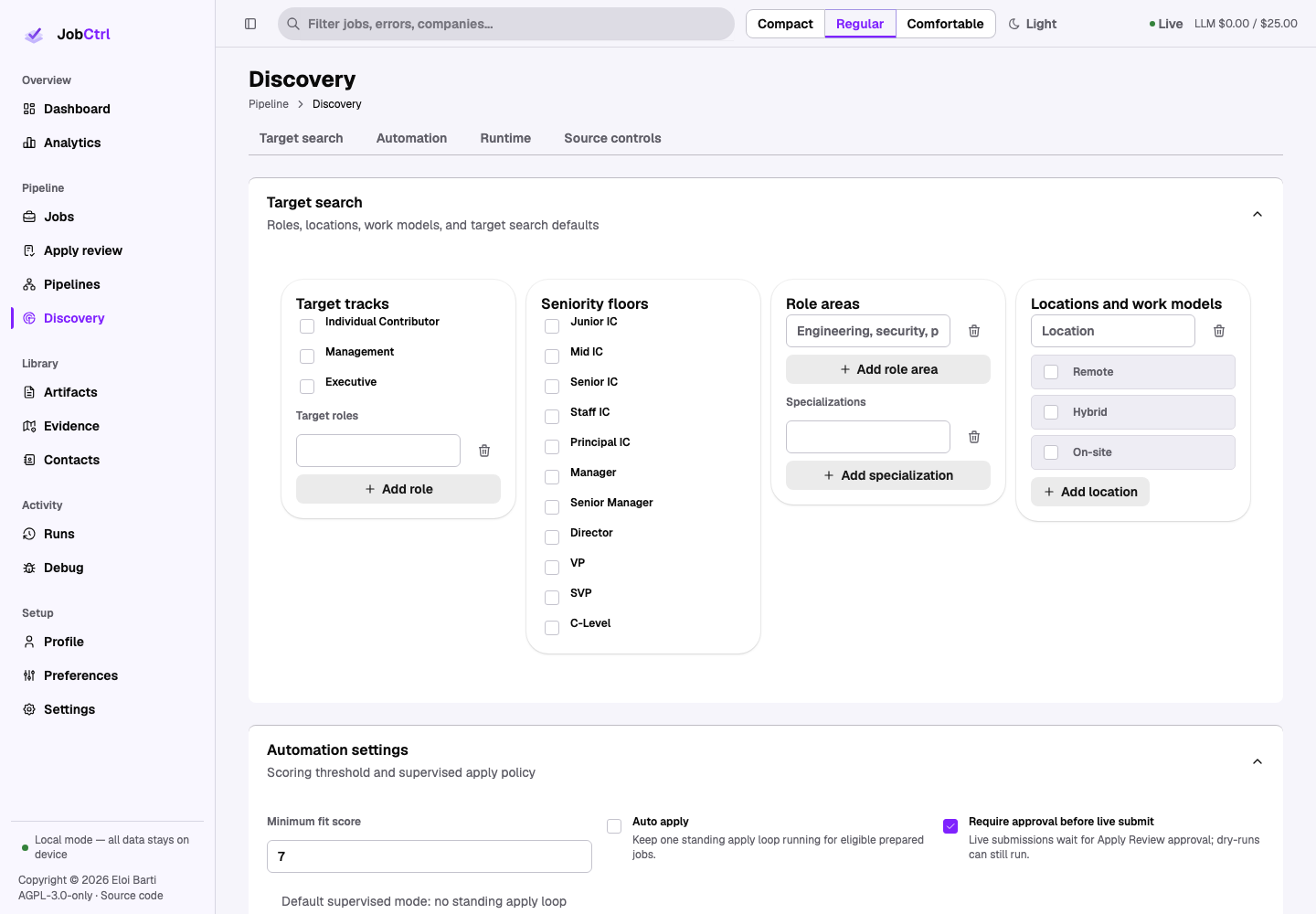 Discovery owns the SQLite-backed controls that shape source intake; Pipelines launches and observes the resulting execution.
Discovery scheduling is also a SQLite-backed setting: scheduling_enabled defaults to false, schedule_cron defaults to 0 7 * * *, and worker startup reconciles the local Temporal schedule — creating it (with SKIP overlap semantics) when enabled and deleting it when disabled.
Employer Analysis Perspectives
After Discovery accepts a posting, the Discover preparation workflow turns it into one structured, inspectable reading of the employer's requirements, priorities, and ideal candidate. Each enabled provider first analyzes the posting independently. JobCtrl compares those drafts, records agreement and provider failures, and asks a ready provider to synthesize the surviving drafts into the canonical analysis used by scoring and tailoring.
Choose the participating providers under Settings → Model selection → Employer analysis perspectives. This provider policy is a non-secret Settings value stored in config.json; it is not a /discovery field. One ready provider is sufficient. Adding more perspectives can expose disagreements and improve the evidence available to synthesis. If an optional perspective fails, preparation continues with the successful drafts; it stops only when no draft succeeds. Changes apply to the next employer analysis.
Crawl Politeness
Every discovery/enrichment fetch routes through one politeness gateway (robots.txt + per-host rate limit + per-run budget + honest user-agent). The defaults are conservative and fail-closed and need no configuration; the one value you should review before real crawls is the outbound user-agent under Discovery → Runtime settings. Both its product token and optional contact are persisted in SQLite with the rest of the page.
The effective identity is <product>/<version> (+<contact>) — for example JobCtrl/0.3 (+https://github.com/ebarti/JobCtrl). It never impersonates a browser. The built-in default points at the public project repository, not any personal identity; owners should review it (and set a contact they own) before crawling real sites — jobctrl doctor prints the effective value.
The rest of crawl policy also lives on the SQLite-backed Discovery boundary, so per-source overrides ride the existing registry rather than a parallel config surface:
- Per-host rate/concurrency + per-run request budget are fields on each source's
SourcePolicy(domain/discovery/source_registry.py), with conservative fail-closed values (robots honored for page rendering, a non-zero min-interval, a concurrency of one, a finite run budget). Per-source overrides ride the existingSourceRegistryEntryrows; a registry policy editor is a planned addition, not yet in the UI. - Broad boards (
indeed,linkedin,glassdoor,zip_recruiter) are fetched by JobStreaming, which owns its board transports — JobCtrl cannot robots-gate or count its per-board requests, so it applies budget + pacing at the invocation boundary only, andjobctrl doctorwarns when they are on. - A malformed
proxyvalue (the SQLite discovery setting,host:port[:user:pass]) now fails loud rather than silently degrading to a direct connection, so a crawl never quietly runs without the proxy you intended.
Contact Research
Supervised contact research has no configuration keys and no schedule — it runs only when you start a run from the UI. Its posture is conservative by design:
- No public source is auto-fetched. A public page is fetched only when you supply its URL for that run (per-source opt-in); with no URL, the run fetches nothing and just records the source-attempt audit.
- Login-walled / paywalled / bot-protected pages are never auto-fetched — they are routed to the manual-capture path instead.
- Fetching reuses the crawl-politeness gateway above (
robots.txt+ per-host rate limit + per-run budget + the same honest user-agent). - LLM spend reuses the daily budget (
dailyBudgetUsd) and the same preflight as every other spendful workflow — there is no separate research budget.